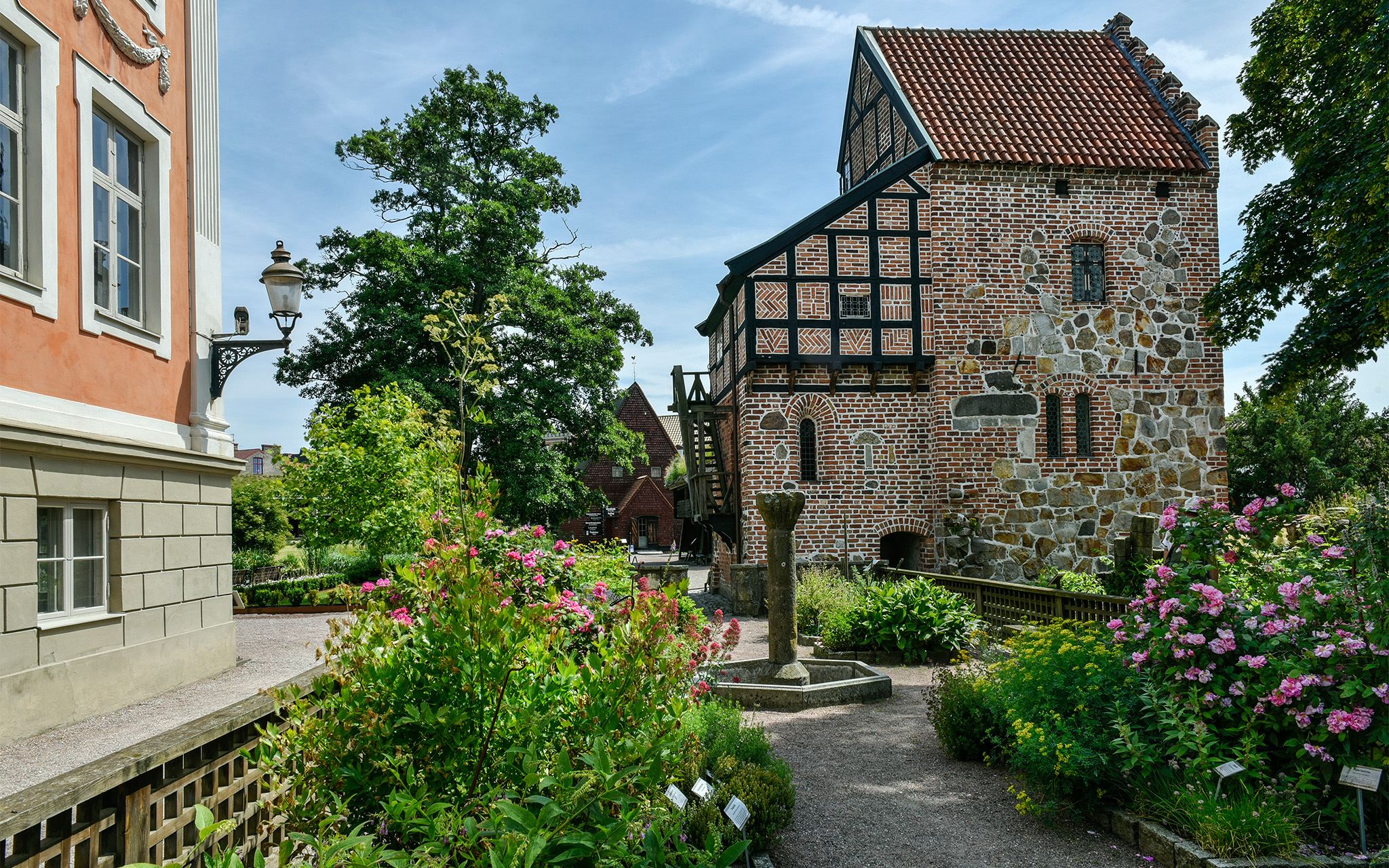
The Herb Garden is inspired by medieval monastic gardens. Monasteries cultivated medicinal herbs to care for the sick. Herbs were also used as spices in cooking. You'll find information about the various herbs in a PDF at the bottom of the page!
Rest and meditation
Monastery gardens were often designed symmetrically, creating a sense of order and harmony. They were divided into sections where plants could be arranged by theme. Water, symbolising purity and life, was a common feature. The monastic garden was both practical and a place for rest and meditation – a paradise on earth.
Healing Traditions
Knowledge of the medicinal properties of herbs was not confined to monasteries. There has long been a tradition of passing on knowledge of plants’ healing effects from person to person. Plants could also hold significance in folk belief and tradition.
Four quarters
Kulturen’s enclosed herb garden was established in 1952 at the proposal of Axel Törje, the head university gardener. A cross-shaped pathway divides the garden into four quarters, each containing different plant species.
At the centre stands a hexagonal fountain forming the focal point of the garden. It features a column with a ribbed capital. Similar capitals can be found in Lund Cathedral. This capital most likely originated from the cathedral’s medieval towers, which were demolished during the restoration led by architect Helgo Zettervall between 1860 and 1880.
Information about the various herbs
Download and read about all the herbs in the herbarium:
The herbarium high resolution (PDF-file 10Mb, opens in a new window)
The herbarium Low resolution (PDF-file 3Mb, opens in a new window)